





Global Statistics
Summary
- In 2025, there were nearly 41 million people living with HIV worldwide, including 1.3 million children under age 15.
- Certain parts of the world are more affected by HIV and AIDS than others. More than half of all people living with HIV in 2025 were in eastern and southern Africa.
- Despite challenges, there has been significant progress in fighting the global HIV epidemic.
The Global HIV and AIDS Epidemic
HIV, the virus that causes AIDS, is one of the world’s most serious public health challenges. However, there is a global commitment to stopping new HIV infections and ensuring that everyone with HIV has access to HIV treatment.
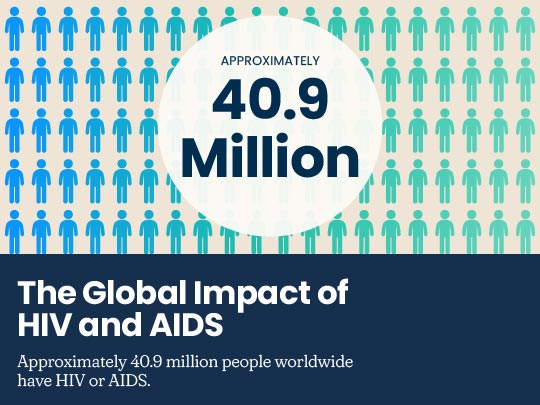
The latest UNAIDS statistics on HIV around the worldExit Disclaimer include:
Number of People living with HIV—There were 40.9 million people across the globe living with HIV in 2025. Of these, 39.7 million were adults (>15 years old), and 1.3 million were children (<15 years old). In addition, 51% were women and girls.
New HIV Infections—An estimated 1.2 million individuals worldwide acquired HIV in 2025, marking a 43% decline in new HIV infections since 2010 and a 65% decline since the peak in 1995. New HIV infections, or “HIV incidence,” refers to the estimated number of people who newly acquired HIV during a given period such as a year, which is different from the number of people diagnosed with HIV during a year. (Some people may have HIV but not know it.) Women and girls accounted for 41% of all new HIV infections in 2025.
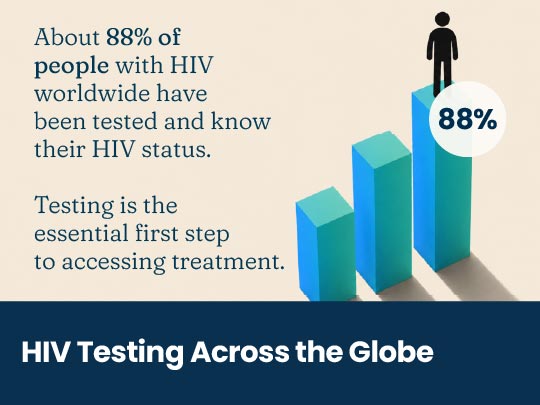
HIV Testing & Knowledge of HIV Status—Approximately 88% of people living with HIV globally knew their HIV status in 2025. About 5.0 million people did not know they had HIV and still needed access to HIV testing services. HIV testing is an essential gateway to HIV prevention, treatment, care, and support services. The global target for HIV status awarenessExit Disclaimer is 95% by 2030.
HIV Treatment Access—As of the end of 2025, 78% of all people living with HIV (32.1 million people) were accessing antiretroviral therapy (ART) globally. HIV treatment access is key to the global effort to end AIDS as a public health threat. People living with HIV who are aware of their status, take ART as prescribed, and get and keep an undetectable viral load can live long and healthy lives and will not transmit HIV to their HIV-negative partners through sex. This is sometimes referred to as “undetectable = untransmittable” or U=U. The global targetsExit Disclaimer include 95% of all people with diagnosed HIV initiating treatment and 95% of those individuals on treatment achieving and maintaining HIV viral suppression.
HIV Care Continuum—The term HIV care continuum refers to the sequence of steps a person with HIV takes from diagnosis through receiving treatment until their viral load is suppressed to an undetectable level. Each step in the continuum is marked by an assessment of the number of people who have reached that stage. The stages are: being diagnosed with HIV; being linked to medical care; starting ART; adhering to the treatment regimen; and, finally, having HIV suppressed to undetectable levels in the blood. UNAIDS reports that in 2025, among all people living with HIV worldwide (diagnosed and undiagnosed):
- 88% knew their HIV status
- Of those who knew their status, 89% were accessing ART
- Of those accessing treatment, 95% were virally suppressed
AIDS-related Deaths—AIDS-related deaths have been reduced by 74% since the peak in 2004. In 2025, around 570,000 people died from AIDS-related illnesses worldwide, compared to 2.1 million people in 2004 and 1.3 million in 2010.
Regional Impact—Certain regions of the globe are disproportionately affected by HIV. Of the 40.9 million people living with HIV in 2025,
- 21.1 million people living with HIV lived in eastern and southern Africa
- 5.2 million lived in western and central Africa
- 7.1 million lived in Asia and the Pacific
- 2.6 million lived in Latin America
- 2.4 million lived in western and central Europe and North America.
Promising Signs of Progress
The HIV epidemic not only affects the health of individuals but also impacts households, communities, and the development and economic growth of nations. Despite these challenges, significant progress has been made in the global response to HIV. Global partnerships and investments have expanded access to HIV prevention, testing, treatment, and care. The number of people who have acquired HIV annually has declined over the years. In addition, the number of people receiving antiretroviral therapy has increased substantially, particularly in resource-limited settings, and dramatic progress has been made in preventing perinatal transmission of HIV and keeping pregnant women alive.
Continuing challenges. Despite the availability of effective HIV prevention tools and access to HIV treatment, progress has not been the same everywhere. UNAIDS reports that gains in reducing new HIV infections, increasing access to treatment, and ending AIDS-related deaths vary across countries and populations. Many people still face barriers to HIV prevention, testing, treatment, and care. Strong partnerships are essential to sustain progress and help end the HIV epidemic.