


Post-Exposure Prophylaxis (PEP)
Summary
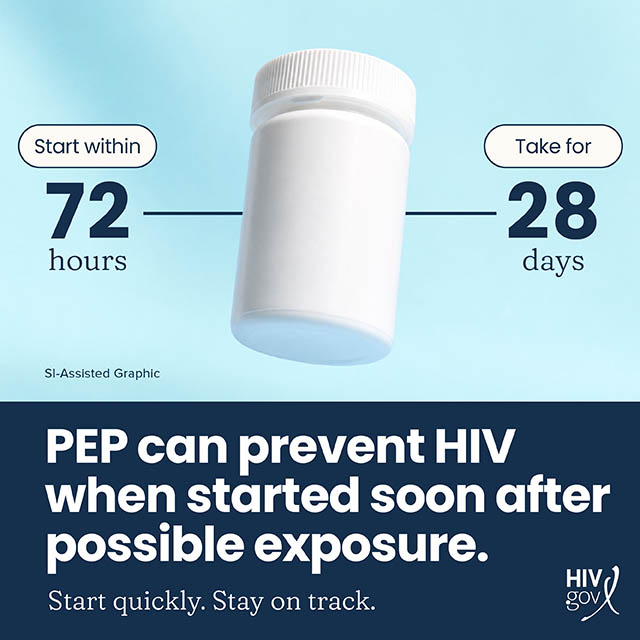
- Post-exposure prophylaxis, also called PEP, is a safe, oral prescription medication regimen that can help prevent HIV if started within 72 hours after a possible exposure. The sooner you start, the better.
- PEP must be started within 72 hours of a possible exposure. It is also important to take PEP every day for a full 28-day course, even if you feel fine.
- If you think you may have been exposed to HIV, talk to your health care provider, visit an urgent care, health center or emergency room, or find a PEP provider near you using the HIV Services Locator.
What Is PEP?
HIV PEP, or post-exposure prophylaxis, is a combination of oral HIV medications you take very soon after a possible exposure to HIV. PEP works by stopping the HIV virus from causing infection in your body.
It is important to start PEP as soon as possible after a known or possible exposure to HIV. You must start it within 72 hours or 3 days, but it is better to start even sooner.
Once you start PEP, take it every day for 28 days, even if you feel fine.
PEP is for emergencies only. It is not meant for regular use by people who may be exposed to HIV frequently. If you need ongoing HIV prevention, talk to your health care provider about PrEP, or pre-exposure prophylaxis, a medicine that reduces the risk of getting HIV.
What Medications Are Used for PEP?
PEP is a combination of three oral HIV medicines taken together every day for 28 days.
The CDC provides clinical guidelines for PEP, including what medicines to use and recommendations for specific groups of people, such as adults and adolescents, children, and pregnant women. A health care provider will determine which PEP medicines are right for you based on your age, pregnancy status, and other medicines you take.
Find additional information about the 2025 CDC-recommended HIV medicines used for PEP.
How Do You Know If You Need PEP?
PEP may be right for you if you are HIV-negative or you do not know your HIV status, and you think you may have been exposed to HIV in the last 72 hours through:
- Sex (for example, you had condomless sex or a condom broke with a partner of unknown HIV status or a partner with HIV who does not have a suppressed viral load, and you were not using PrEP)
- Shared needles, syringes, or other equipment used to inject drugs
- Sexual assault
- Workplace exposure such as from needlestick injury. Workplace HIV transmission is extremely rare.
Where Can You Get PEP?
If you think you have been recently exposed to HIV, contact a health care provider or local health department immediately or go to an emergency room or urgent care clinic right away. Do not wait since starting within 72 hours is important.
Your health care provider, or a provider at a health department, an urgent care, or an emergency room will evaluate you, help you decide whether PEP is right for you, and work with you to determine which medicines to take for PEP. Visit a health center or use the HIV.gov Locator to find PEP services near you.
Pharmacists can also prescribe PEP in Arkansas, California, Colorado, Connecticut, Florida, Georgia, Illinois, Louisiana, Maine, Maryland, Missouri, Minnesota, Nevada, New Jersey, New Mexico, New York, North Carolina, Oregon, Rhode Island, Tennessee, Utah, and Virginia.
For clinical decision-making, health care providers and pharmacists can review the Post-Exposure Prophylaxis (PEP) factsheet and the latest HIV/AIDS treatment guidelines to ensure optimal patient care.
Frequently Asked Questions About PEP
How Long Do You Need to Take PEP?
If you are prescribed PEP, you will need to take the HIV medicines every day for 28 days. It is important to take all the doses as prescribed to give PEP the best chance of working.
You will also need to return to your health care provider at certain times while taking PEP and after you finish taking it for follow-up HIV testing at 4 to 6 weeks and at 3 months and for other lab tests.
How Well Does PEP Work?
PEP is effective in preventing HIV infection when it is taken correctly, but it is not 100% effective. The sooner you start PEP after possible HIV exposure, the better.
While taking PEP, it is important to use other HIV prevention methods, such as using condoms the right way every time you have sex and using only new, sterile needles and syringes when injecting drugs. It is a great time to consider going on PrEP. Talk with your health care provider to learn more.
Does PEP Cause Side Effects?
PEP is safe, but the HIV medicines used for PEP may cause side effects like nausea in some people. In almost all cases, these side effects can be treated and are not life-threatening.
If you are taking PEP, talk to your health care provider if you have any side effects that bother you or that do not go away. They might be able to prescribe medications that can help improve those side effects. Do not stop taking PEP without talking to your health care provider first.
PEP medicines may also interact with other medicines that you are taking (called a drug interaction). For this reason, it is important to tell a health care provider about any other medicines that you take, including over-the-counter medications, alcohol, and non-medical drugs.
Can You Take PEP When You Are Pregnant or Breastfeeding?
Yes. PEP is safe during pregnancy and breastfeeding. If you are pregnant, think you might be pregnant, or are breastfeeding, talk to a health care provider about PEP and which PEP regimen is right for you.
Can You Take PEP Every Time You Have a Potential Exposure to HIV ?
PEP should be used only in emergencies. It is not intended to replace regular use of other HIV prevention methods. If you think you might be exposed to HIV a few times a year, talk to your health care provider about going on PrEP (pre-exposure prophylaxis).
How Can You Protect Yourself from HIV after PEP?
After finishing your 28-day course of PEP, talk to your health care provider about HIV prevention options if you think you may be exposed to HIV again, either sexually or through injection drug use. You may want to start PrEP (pre-exposure prophylaxis) to continue to reduce your risk for getting HIV.
How Can You Pay for PEP?
In many states, PEP is covered by health insurance, including Medicaid.
If you do not have health insurance, or you need help paying for PEP co-payments, there are some programs that might help you get free or low-cost PEP medicines:
- If you do not have insurance—Some pharmaceutical companies have patient assistance programs (PAPs) to help people who do not have insurance or whose insurance does not cover a specific medication to have access to the medications they need at no or low cost. Requests can be handled urgently in many cases to avoid a delay in getting PEP. The health care provider who prescribes PEP for you may be able to help you complete the forms. Find a list of PAPs for PEP medications and read about how to access these programs.
- If you have insurance but need help covering the costs of co-payments—Some pharmaceutical companies have co-payment assistance programs (CAPs) to help people who have insurance to lower or eliminate the amount they owe as a deductible, co-insurance, and/or co-payment for a specific medication. The health care provider who prescribes PEP for you may be able to help you complete the forms. Find a list of CAPs for PEP medications and read about how to access these programs.
- If you are prescribed PEP after a sexual assault—You may qualify for partial or total reimbursement for medicines and clinical care costs through the Office for Victims of Crime, funded by the U.S. Department of Justice. Find state victim compensation contact information.
- If you are a health care worker exposed to HIV on the job—Your workplace health insurance or workers’ compensation will usually pay for PEP.