




Summary:
National Women and Girls HIV/AIDS Awareness Day, which takes place on March 10, is an observance during which we mark the impact of HIV and AIDS on women and girls. For the 2026 awareness day, HIV.gov is highlighting the importance of HIV testing, prevention, and care and how these efforts are critical to protect the health of women.
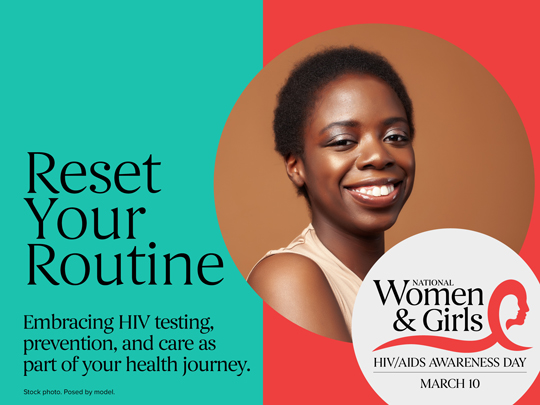
March 10, 2026 is National Women and Girls HIV/AIDS Awareness Day (NWGHAAD). It’s an important day to recognize the impact of HIV and AIDS on women and girls. It’s also an observance during which we highlight the importance of taking proactive steps to help protect the health of women. The theme for the 2026 awareness day is “Reset Your Routine: Embracing HIV testing, prevention, and care as part of your health journey.”
“National Women and Girls HIV/AIDS Awareness Day is an important opportunity for us to pause and refocus our efforts to help women prevent and treat HIV,” said Kaye Hayes, MPA, Deputy Assistant Secretary for Infectious Disease and Director of the Office of Infectious Disease and HIV/AIDS Policy (OIDP). “We invite you to join us in protecting women by raising awareness for HIV prevention, testing, and care in their health journey.”
Preliminary data reported to CDC show that, in 2024, nearly 8,000 women and girls ages 13 and older received an HIV diagnosis in the United States. During that time, women made up about 20% of new HIV diagnoses, according to America’s HIV Epidemic Analysis Dashboard (AHEAD). The highest number of new HIV diagnoses were among women ages 25 to 44.
For this year’s awareness day, HIV.gov is highlighting how critical it is to take proactive steps to prevent and treat HIV in women. Tools for preventing HIV include:
- Testing. Knowing your HIV status is critical. The most current estimates (2022) indicate that about 13% of people in the United States who have HIV, do not know it. That’s why regular testing is key. Get tested regularly, so you can protect your own health and the health of your partner. Find out who should get tested and more about HIV testing.
- HIV prevention medicine. If someone tests negative for HIV, they can use medicines to prevent HIV. These medicines are called pre-exposure prophylaxis (PrEP) and post-exposure prophylaxis (PEP). PrEP is taken on a regular basis to prevent HIV before a potential exposure and PEP is taken in an emergency situation after a potential HIV exposure. Both PrEP and PEP are safe and effective prescription medicines that can reduce the risk of getting HIV.
- HIV treatment medicine. If someone tests positive for HIV, they can use this knowledge to take action to get HIV medicine called ART, or antiretroviral therapy. ART suppresses the virus to limit, reducing its impact on the body and helping people living with HIV live long, healthy lives. ART can also prevent people living with HIV from giving HIV to others, and can help prevent HIV from being passed from a mother to her baby.
What can you do on March 10 to help us mark this awareness day? Use the resources below to help spread these important messages:
- Social Media Toolkit: View and share the messages and graphics in our social media toolkit to help spread the word about the importance of NWGHAAD.
- HIV Services Locator: Use and share our HIV Services Locator, which can be used to find nearby HIV testing, ART, PrEP, and PEP.
Visit our NWGHAAD page to learn more about this awareness day.